
I really enjoyed my career in academia, but it stifled my creativity in a way that I did not enjoy.
For example, from 1998 to 2006 I had an incredible output of creative writing activity.
It was fun to do.
I wrote to keep my imagination engaged.
I wrote because I enjoyed the challenge of making words sing and dance.
I wrote because it was fun. Fun to do.
I never quite mastered the long form narrative.
Short stories, poems, and simple rhymes and thoughts are easier to capture and commit to paper.
And I did write on paper, notebook paper to be exact, and I used a ballpoint pen. My pen of choice was a Dr. Grip Center of Gravity pen manufactured by Pilot.
As time has progressed, I now use a laptop. Easier for organization and storage of the written word.
Yet, there is something special about transforming thoughts into words and committing them to paper using an ink pen. The organic quality of ink and paper does not compare to writing on a laptop or a device.
Writing by hand recalls a primality of basic tool use.
A hand utilizing a pen to commit a word to a physical medium so it will live and not be lost.
Awesome.
I would use pen and paper more often, but sometimes I forget to put the pen back into my pocket. Sometimes I leave my notebooks places from which they never return.
The practice of writing creatively using pen and paper came to a gentle conclusion when I started my doctoral program in summer of 2009.
I placed my creativity into a state of dormancy.
Why do such a thing?
While creativity is useful in academia and should not be discounted, I needed my focus to conform to the parameters of academic dialogue.
In academia, protocol is incredibly important.
Protocol must be followed to meaningfully contribute to the ongoing conversation.
And as an up-and-coming member of academia, I wanted to follow protocol.
Thus, the long dormancy began.
I would, on two distinct occasions, reawaken my creativity and put it to use, but like an atrophied muscle it had limited strength and could only do so much.
I ask for your patience, dear reader, with a brief interlude on the nuances of creative writing.
One of my warmup exercises in preparation for writing creatively, or any sort of writing, is to go somewhere where a lot of other people are gathered and to sit down and just listen.
Listen to the multitude of words being spoken.
As I listen, I write down whatever impressions and illustrations appear in my mind’s eye.
One such example can be found in the following short poem:
Fade
White.
Fade in…
I sat across from two girls eating.
One of them looked back at me
across the room.
Soon I faded out of sight
and there were no girls and the room
disappeared and I had never been there.
Fade out…
Black.
According to the notebook in which I wrote this poem it was a Wednesday afternoon, October 8th, 2003, in the food court of the Parks Mall in Arlington, Texas.
Picture for reference:
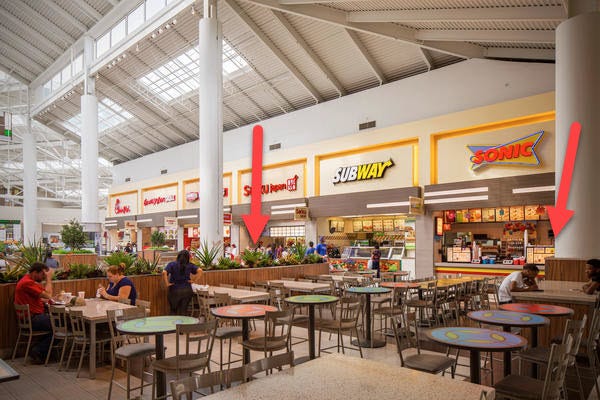
The red arrow indicates the area where I usually sat. The other red arrow indicates where the two girls had been sitting who appear in Fade.
I did not leave any notes to myself or future readers about what inspired Fade. I do not think there is any deeper meaning to be found other than it was fun to work in abstractions.
However!
I can trace some of the inspiration of Fade to an undergraduate creative writing class assignment in which we had to read poetry journals and select and critique a poem that we liked.
I found a poem I liked in North American Review with a stanza from an Edward Hirsch poem called “Parables”. One short stanza that stood out to me goes as follows:
“All night the girl looked out the window
Until the window disappeared
And there was no girl.”
This poem is so simple and is almost like a daydream.
I love it.
I can only hope Edward Hirsch would appreciate my attempt to use his style and visual storytelling.
I will honor Edward Hirsch and his influence on me in 2003 by revisiting Fade and offering an improved revision almost twenty years later.
This is a revision of my own poem that may or may not reflect a noticeable development in talent or imagination.
Or maybe this was just fun to write:
Slow Fade
All we see is White.
Fade in…
At fixed point in time
I am sitting by myself
And across the room two girls are eating.
One of the girls returns my gaze.
At a later point in time
Perhaps fixed, but uncertain
I am slowly fading away
and there were no girls eating
and the room disappeared
as if I never been there at all.
Fade out…
Black.
Thank you, Edward Hirsch.
Not much of an improvement, dear reader, but the point of it was that the 2023 version took only moments to visualize and write.
I used a computer and typed the new and revised version rather than laboring with pen and paper.
Do I have another, more mature and evolved piece to offer as a demonstration of growth?
As a matter of fact, I do.
In the long dormancy there were two instances of creativity.
An instance in 2011 and again in 2019.
Two moments of creativity in a ten-year period (2009 to 2019).
You don’t get it?
Neither do I.
I am going to present the latter instance before the former, earlier one.
My reasoning being that the earlier instance comes with a story that is fun to tell.
The following was written circa 2019, and represents a moment in which my creativity appeared, albeit briefly, and then disappeared back into dormancy.
I know the exact influences for this particular piece was a 2019 Twitch broadcast by streamer OhBby who was raising money for mental health awareness.
In 2019 I had worked with several students who were struggling with depression, so I had somewhat of an understanding of what they were feeling.
Also influencing this piece was my reading on Søren Kierkegaard, an incredible thinker from Denmark who struggled with despair throughout his life. Kierkegaard reasoned that despair was different from depression in that despair was a loss of hope and that loss of hope was a spiritual sickness, an idea he explores in excellence in The Sickness Unto Death.
Lastly, I am particularly fond of the song “Black Eyed Dog” by Nick Drake. In the song Drake seems to view his dog not as an enemy, but as something that wants more, and Drake simply has nothing left to give.
This is a snapshot of where I was at a fixed point in time in 2019 and what I was thinking about at said fixed point in time with the previously mentioned influences coming together in my imagination. I was not depressed at the time, but I wanted to put into words what it looked like in my mind’s eye:
I Have A Dog; His Name is Despair
I have a dog; his name is Despair.
He located me in late adolescence
stepping into my vision from out of my shadow
and whispering into my ear
he reminded me of that which had been lost
and could not be recovered.
He whispered these things into my ear
and then stepped back into my shadow
reassuring me he’d back soon
very soon
never far away
always close
always there.
Written by Andrew F. Rosbury
March 16th, 2019
The above is a work in progress. I have to wait for the other pieces of this poem to appear in my mind’s eye. As of now, it remains incomplete.
A creative writer’s note: the imagery and ideas in this work are recurring in that the image of a dog that troubles me appeared in a previous poem, circa 2005, that I wrote about visiting Sundance Square in Fort Worth, Texas. The image of the troublesome dog also appeared in an earlier, unsophisticated attempt at expressing feelings of regret over a relationship that went nowhere, circa 2001 and 2004. The title of the unsophisticated poem is better than it’s actual content. That title being If My Tears Fell As Diamonds.
I am a fan of dogs and mean them no offense. The dog as metaphor appears in literature and music and I simply borrowed the image from other, better writers. My thanks to them for allowing me to do so.
Sometimes the images created from words and ideas can recur and come to live and occupy space in other works.
More on this at a later, fixed point in time.
Ideas are organic things. As are words.
Thus, the long dormancy ends with renewed germination.
 Andrew F. Rosbury
Leave a comment